Top Forest Urban Hotels in America: An Asset Audit & Strategic Selection Guide
The American metropolitan top forest urban hotels in america experience is frequently defined by the imposition of the grid upon the natural landscape—a historical process of land clearing and infrastructure deployment that leaves little room for the arboreal. Yet, a specific and highly valued segment of the hospitality industry has emerged to challenge this dichotomy: the urban hotel that manages to integrate, preserve, or simulate a legitimate forest ecosystem within a dense metropolitan footprint. These are not merely hotels with gardens; they are properties that operate as high-performance environmental assets, where the forest is not a decorative backdrop but a functional element of the guest’s spatial experience.
Identifying the best examples of these venues requires an analytical framework that separates superficial greenwashing—potted plants in a lobby—from genuine biophilic integration. The top forest urban hotels in america operate at the intersection of complex zoning, arboricultural maintenance, and high-density hospitality logistics. These venues require massive capital investment in root-system protection, light-well architecture, and specialized irrigation, all while maintaining the operational standards of a modern, multi-story urban hotel.
For the professional traveler or the discerning observer, navigating this category involves recognizing that these hotels are a form of urban resilience. They provide a critical service by acting as “green lungs” within the city, mitigating the heat island effect and providing essential psychological relief. This article serves as an audit of the structural, economic, and logistical realities that define this unique asset class, providing the tools necessary to differentiate between mere landscaping and true arboreal integration.
Understanding “top forest urban hotels in america”
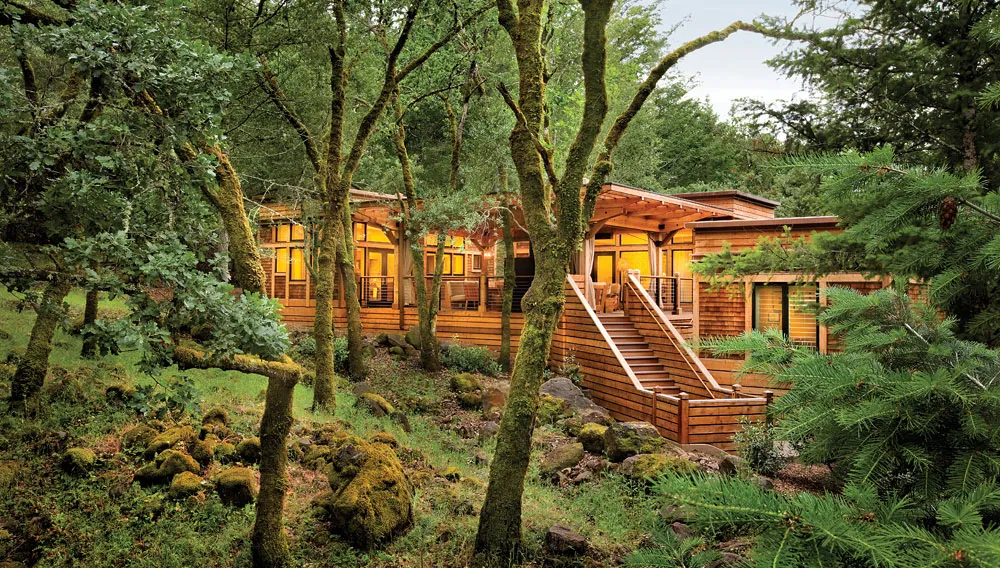
When one attempts to define the “top forest urban hotels in america,” the primary challenge is overcoming the conflation of “park-adjacent” and “forest-integrated.” A hotel situated across the street from a public park is not a forest urban hotel. The latter category is defined by a deep-tissue integration where the architecture, the local micro-climate, and the physical presence of tree canopy are inextricably linked. The property must exist within the forest, rather than alongside it. This distinction is critical because the operational challenges scale exponentially when the hotel building itself must account for root systems, canopy clearance, and the specific humidity requirements of a forest patch.
The common misunderstanding is that these hotels prioritize the “aesthetic” over the “operational.” In fact, the inverse is often true. To maintain a healthy forest ecosystem within a city boundary—where air quality, soil compaction, and light access are compromised—requires more operational rigor than a standard hotel. These properties must manage soil pH, deal with urban pests, and ensure that the building’s foundation does not desiccate the very trees that give the property its identity. The top forest urban hotels in america are, therefore, masters of engineering as much as they are masters of hospitality.
Furthermore, these hotels serve as a necessary counter-balance to the intensity of urban movement. The “forest experience” in this context is a functional requirement for high-level productivity and recovery. Oversimplification risks arise when analysts treat these assets as luxury “extras.” For the strategic planner, the forest element is a hard-cost asset that requires ongoing stewardship. Recognizing this—that the forest is an infrastructure, not just a view—is the first step toward genuine topical mastery of this niche.
Deep Contextual Background: The Evolution of Urban Arboriculture
The development of these hybrid hotels is rooted in the 19th-century “City Beautiful” movement, which advocated for the integration of grand boulevards, public parks, and tree-lined avenues to counteract the grim reality of industrial urbanism. However, the modern iteration is a byproduct of the “Biophilic Design” movement of the 21st century. As corporations and travelers began to quantify the productivity gains associated with nature exposure, the value proposition of the “forest hotel” shifted from an aesthetic choice to an economic necessity.
In cities like Seattle, Portland, and even pockets of the Northeast, developers began to treat the tree canopy as a critical density-management tool. They moved beyond planting saplings, instead preserving old-growth pockets or creating multi-level, engineered “forests” within atriums and rooftops. This systemic evolution reflects a broader shift: the city is no longer viewed as a place to exclude nature, but a place to re-engineer it. The top forest urban hotels in america have become the vanguard of this re-engineering, providing a blueprint for how high-density living can coexist with significant, sustained arboreal presence.
Conceptual Frameworks and Mental Models
To evaluate these assets, analysts should employ the following models:
-
The Canopy-Infrastructure Index: This measures the ratio of tree canopy cover to building footprint. Does the architecture accommodate the trees, or does it merely tolerate them? A high index indicates a property where the forest is a primary driver of building design.
-
The Micro-Climate Buffer: This assesses the thermal and acoustic mitigation provided by the forest element. A forest hotel should demonstrate measurable differences in ambient temperature and noise levels compared to a standard concrete-and-glass property one block away.
-
The Root-Integrity Model: A more technical framework that evaluates how the hotel foundation interacts with the local soil table. Does the property use suspended pavement systems or other technologies to ensure tree health in an urban, subterranean context?
These frameworks shift the focus from “how does it look” to “how does it work.”
Key Categories and Variations of Forest-Integrated Assets
The market for these hotels can be segmented by the nature of their integration.
When selecting from the top forest urban hotels in america, the decision should be guided by the “operational purpose.” An “Engineered Forest” property is excellent for high-density networking, whereas an “Adaptive Canopy” property provides the sensory isolation required for executive focus.
Detailed Real-World Scenarios
Scenario 1: The Executive “Deep-Work” Sprint
-
Constraint: A team requires a space that eliminates the “urban hum” while maintaining proximity to a central business district.
-
Decision: Choosing an “Adaptive Canopy” property where the building is nestled within an existing, mature forest patch.
-
Failure Mode: Selecting a hotel that advertises a “forest view” but provides no acoustic buffer from the adjacent city traffic.
-
Second-Order Effect: The team suffers from “sensory leakage,” where the urban stress persists despite the visual evidence of nature, leading to a failed retreat.
Scenario 2: The Large-Scale Tech Summit
-
Constraint: Hosting 500 attendees needing a central hub with biophilic design to enhance “cognitive refresh.”
-
Decision: An “Engineered Forest” property with a massive, climate-controlled atrium.
-
Failure Mode: Underestimating the maintenance costs of an indoor forest, leading to a degraded, brown, or unkempt atmosphere during the event.
-
Second-Order Effect: The brand image is tarnished; the “nature” promise feels like a failed corporate gimmick.
Planning, Cost, and Resource Dynamics
The economic evaluation of these properties must account for the “Biophilic Premium”—the extra cost of maintaining nature within a dense urban environment.
-
Direct Costs: Specialized horticultural staff, soil aeration, supplemental lighting, water filtration, and structural maintenance.
-
Indirect Costs: Increased HVAC complexity to manage humidity levels near vegetation, and the insurance burden of maintaining high-value mature trees.
-
The Maintenance Offset: While the operational costs are higher, these properties often command a price-per-room premium because they function as a “destination” rather than a commodity.
Tools, Strategies, and Support Systems
-
Arboricultural Site Survey: Before committing to a high-stakes event, request the hotel’s “Canopy Maintenance Report.” A professional venue will have an active management plan for its trees.
-
Acoustic Mapping: Use an SPL (Sound Pressure Level) meter during a site visit. A true forest hotel will have a distinct acoustic profile—muffled, low-frequency dominance—rather than the sharp, high-frequency clatter of the city.
-
Light-Level Audits: For hotels relying on internal atriums, ensure there is active grow-light supplementation. Natural light in a deep urban canyon is often insufficient for mature forest health.
-
Zoning Verification: Check the local municipal plans. Is the “forest” protecting the hotel a permanent asset, or is it future development land?
Risk Landscape and Failure Modes
The “Forest-Urban Risk Taxonomy” includes several compounding factors:
-
The Stagnation Risk: A forest patch in a city can become a “dead zone” if the horticultural team lacks expertise. The trees don’t just grow; they struggle against urban pollutants.
-
Structural Compromise: If a foundation shifts due to soil saturation (necessary for trees), it can create massive, multi-million dollar repair costs.
-
The “Pest” Factor: Urban trees attract unique pest populations. A well-managed property has an Integrated Pest Management (IPM) plan; a poorly managed one will have guests complaining about infestations.
-
Regulatory Rigidity: In many cities, cutting down a tree is a legal nightmare. If a tree on the hotel property becomes a hazard, the bureaucracy can prevent necessary removal, creating a safety risk.
Governance, Maintenance, and Long-Term Adaptation
If an organization manages a high volume of events at these properties, it must establish a governance structure for venue procurement:
-
The Green-Asset Audit: Maintain a rolling evaluation of the property’s horticultural health. If the trees look stressed, the property is failing.
-
Review Cycles: The “Forest Audit” should occur every 24 months. Has the canopy expanded or receded?
-
The Layered Checklist:
-
[ ] Does the hotel employ a full-time arborist or horticulturalist?
-
[ ] Is the irrigation system automated and moisture-sensor-based?
-
[ ] Are there visible signs of tree distress (wilting, yellowing, urban blight)?
-
[ ] Is the forest zone actively shielded from urban light pollution at night?
-
Measurement, Tracking, and Evaluation
-
Leading Indicator: “Canopy Vigor Score”—a qualitative assessment of leaf density and color during a site visit.
-
Lagging Indicator: “Biophilic Satisfaction Survey”—a post-event survey specifically asking about the perceived mental clarity and stress-reduction provided by the environment.
-
Documentation: Keep a “Arboreal Log” for recurring event sites. This helps track if the “forest” is being maintained or if it is being slowly allowed to decline to save on costs.
Common Misconceptions and Oversimplifications
-
Myth: “A forest hotel is better for the air.” Correction: Only if it’s large enough to act as a significant carbon sink. Smaller atriums are largely psychological; they don’t significantly clean the air of a whole building.
-
Myth: “Trees don’t need maintenance.” Correction: Urban trees are high-maintenance objects. Without constant input, they fail.
-
Myth: “All greenery is the same.” Correction: There is a massive difference between “ornamental landscaping” (flowers and shrubs) and a “forest” (trees, canopy, understory). The latter is an order of magnitude more complex to manage.
-
Myth: “The hotel manages itself.” Correction: These are hybrid industrial-biological facilities. They require a management team that understands both hospitality and ecology.
-
Myth: “I can just open the windows.” Correction: In an urban forest, you have to balance the forest micro-climate with the noise and pollution of the city.
Ethical, Practical, and Contextual Considerations
The preservation of mature trees within an urban hotel development is a significant ethical commitment. These trees provide cooling, habitat for urban wildlife, and carbon sequestration. By choosing to stay at the top forest urban hotels in america, travelers are essentially acting as patrons for these urban green zones. However, guests must recognize the limitation: these are managed environments. The ethical guest respects the forest zone, minimizes waste, and understands that the maintenance of this space is a delicate act of balancing ecological needs with human demand.
Conclusion: The Synthesis of Utility and Canopy
The search for the top forest urban hotels in america is a search for an anomaly: a place where the logic of the city and the logic of the forest occupy the same coordinate. By applying a systematic, audit-based approach to procurement, organizations can move beyond the surface-level marketing of “green hotels” and identify those properties that are genuinely investing in the biological health of their infrastructure. Mastery of this selection process is the hallmark of the professional who understands that in an increasingly urbanized world, the true luxury is the ability to breathe, think, and work beneath a canopy that should not exist, yet somehow does. It is a testament to human ingenuity and a necessary sanctuary for the modern mind.